


The Boat People - An Age Investigation
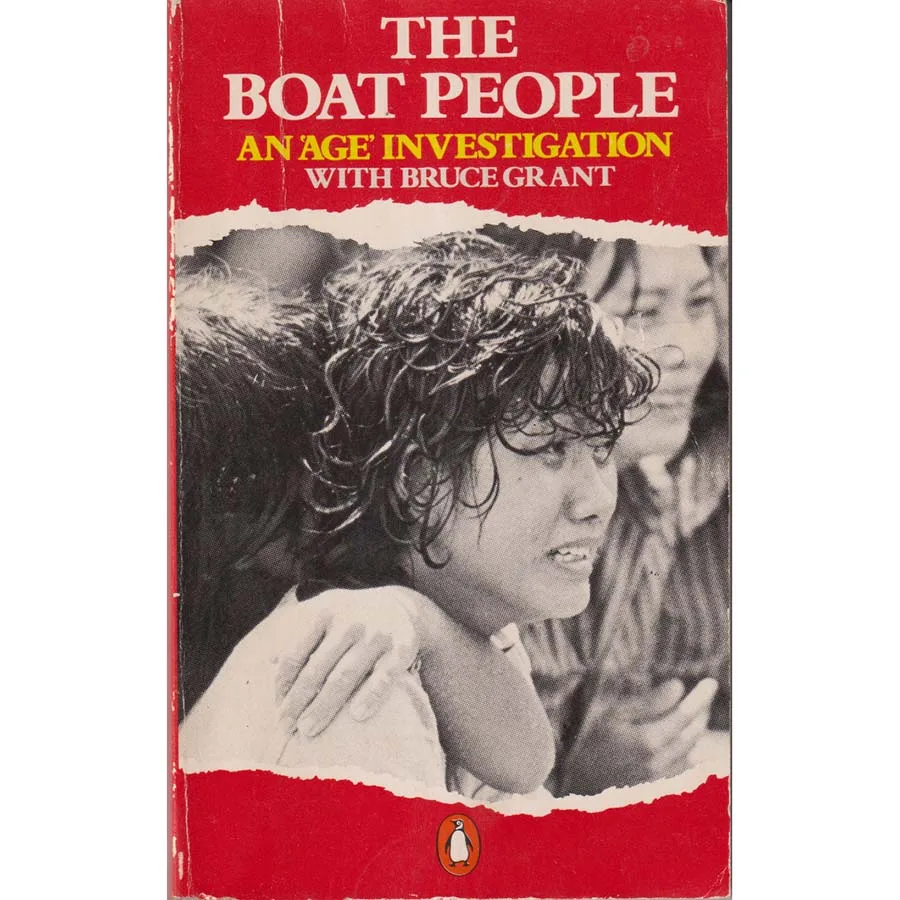
Publisher: Penguin
Format: Paperback
ISBN: 0140055312
The Boat People - An Age Investigation by Bruce Grant, published by Penguin in 1979, is a contemporary investigation into one of the defining humanitarian crises of the late 1970s: the flight of large numbers of people from Vietnam and neighbouring parts of South-East Asia, many attempting extraordinarily dangerous sea journeys in small and overcrowded boats.
This is not history reconstructed comfortably several decades later. It was written while the crisis was actually unfolding, when governments, aid organisations and journalists were still trying to understand what was happening, where the refugees could go and which country might reluctantly agree that the problem was partly its responsibility.
Produced from an international investigation by Australian newspaper The Age, the book draws together reporting on the people making the journeys, the political circumstances behind the exodus and the increasingly difficult international question of what should happen to those who survived.
The term “boat people” became one of the defining phrases of the period, but phrases have an unfortunate habit of turning thousands of individual lives into something conveniently abstract. Behind it were families and individuals abandoning homes, possessions and established lives because remaining where they were had become intolerable or dangerous.
Their escape could then involve an entirely new collection of dangers: unsuitable vessels, storms, shortages of food and water, piracy, uncertain destinations and the possibility of reaching another country only to discover that nobody was particularly enthusiastic about allowing them ashore.
It is difficult to imagine a more brutal demonstration of the difference between a border on a political map and a border encountered while exhausted in an overcrowded boat.
The book also belongs firmly to the Cold War world of the late 1970s. The Vietnam War had ended only a few years earlier, Cambodia was undergoing catastrophe, relations between Vietnam and China had deteriorated, and governments across the region were attempting to respond to large refugee movements while simultaneously considering their own political and diplomatic interests.
Human beings therefore encountered one of civilisation’s more enduring creations: the international conference.
Governments expressed concern, committees met, statements were issued and officials attempted to decide which nation should accept which people. This is generally the point at which history demonstrates that humanity can invent jet aircraft, nuclear reactors and spacecraft while still finding it extremely difficult to agree what to do when several thousand frightened people arrive somewhere unexpectedly.
Because it was published in 1979, the book has particular historical value today. The authors did not know how the refugee crisis would ultimately develop. There was no neat retrospective conclusion available, and events that we can now place comfortably on a timeline were still current affairs.
That immediacy gives books like this a quality later histories cannot entirely reproduce. Statistics had not yet settled into textbooks. Decisions were still being made. People interviewed in the book were not historical witnesses looking back across decades but participants describing events that had only just happened.
There is consequently rather more here than a general account of migration. It is also a snapshot of how journalists, governments and the public understood an international refugee emergency at the moment it was taking place.
And inevitably it invites comparison with the present. Countries still argue over borders, asylum, responsibility and resettlement; governments still prefer problems that occur somewhere else; and political debates still have an impressive ability to reduce complicated human situations to slogans of convenient length.
The technology has improved considerably. The arguments have proved rather more durable.
For readers interested in modern Asian history, Vietnam, refugees and migration, twentieth-century politics, journalism or contemporary accounts of major historical events, The Boat People is an unusually direct piece of documentary reporting from the period itself.
It is also an excellent example of why old current-affairs paperbacks are worth keeping. Yesterday’s disposable journalism has an awkward tendency to become tomorrow’s primary-source material, provided somebody resisted the perfectly understandable urge to throw it away in 1987.
Condition: Good. A sound used copy with normal signs of age and handling. Published in 1979, it has now survived long enough for the events it describes as an immediate crisis to have become established history.
Keep browsing: See more Academic books Other books by Bruce Grant
